KEY TAKEAWAYS
- Safety first, then photos, plates, insurance cards and witness contacts.
- California requires a DMV SR-1 report within 10 days if anyone was hurt or damage is over $1,000.
- Your insurer can't require you to use a particular body shop. The choice is yours.
- Tow the car straight to your chosen shop to avoid storage fees and a second tow.
- A proper repair includes an itemized estimate, factory procedures, color matching and ADAS calibration.
If you were just in a car accident in Fremont, here is the short version: get safe, take photos, swap insurance information, report the crash to your insurer and, if required, to the DMV within 10 days, and then choose the body shop yourself. California rules say the shop is your call, not the insurance company's.
We wrote this guide because we see the same confusion every week at our shop on Albrae Street. People are shaken up, the tow driver is asking where the car should go, and the adjuster is already suggesting a shop. This page walks through every step in order, with the rules that protect you and the mistakes that cost Fremont drivers time and money.
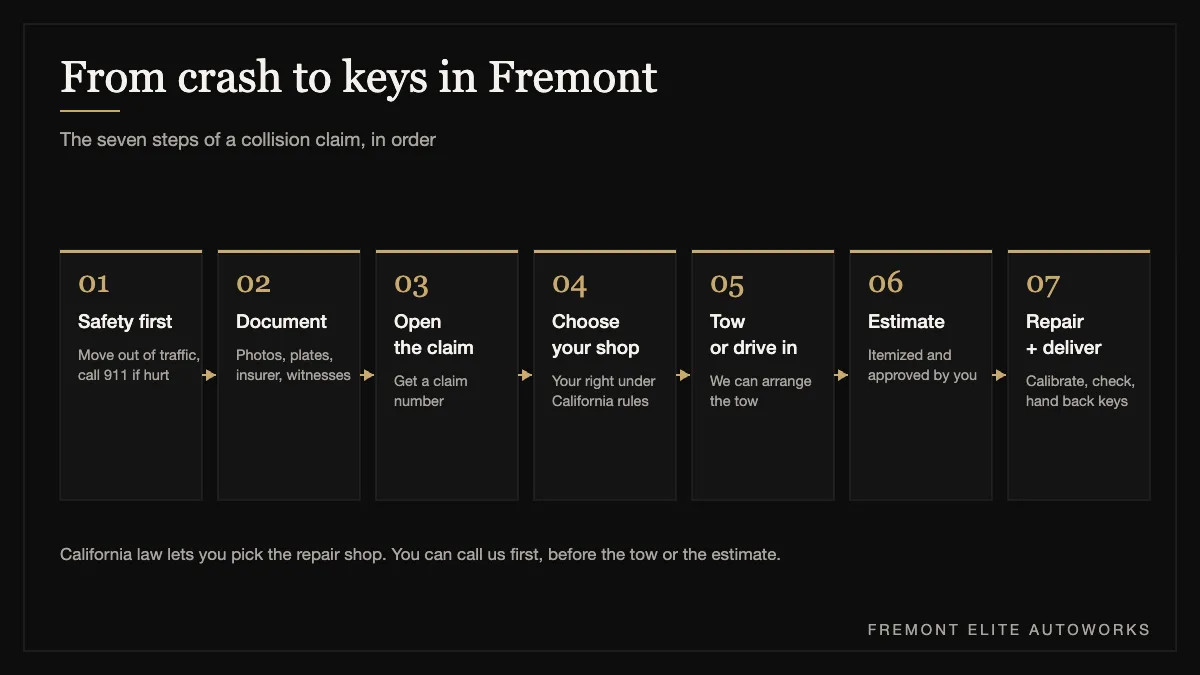
What to do in the first 30 minutes
The first half hour decides how smooth the rest of the claim will be. Focus on safety first and paperwork second.
- Check for injuries and call 911 if anyone is hurt. Don't move someone who might have a neck or back injury.
- Get the cars out of traffic if you can do it safely. On I-880, I-680 or Mission Boulevard, staying in a live lane is often more dangerous than the crash itself. Turn on your hazards.
- Call the police if there are injuries, a hit-and-run, a suspected DUI, or a driver who won't share information. Ask for the report number.
- Exchange information. Name, phone, driver's license number, insurance company and policy number, and the plate and make of every car involved.
- Don't argue about fault at the scene. Stick to facts. Fault gets decided later, by the insurers.
The photos and details that make a claim easy
Adjusters and body shops both work from what you record. Good photos can save days of back and forth.
- Wide shots first. Show both cars, where they ended up, lane markings, signals and street signs.
- Then every damaged area up close. Take several angles, including the wheels and the underside of the bumper if you can see it.
- The other car's plate and insurance card. A clear photo beats a hand-written note.
- Warning lights on your dash. A lit airbag, ABS or collision-warning light tells the shop which systems to check.
- Witness names and numbers. People leave fast. Ask right away.
Write down the time, the exact location (for example, "southbound Fremont Boulevard at Stevenson"), and the weather. You'll be asked for all of it.
How crashes happen in Fremont
Fremont publishes its crash data, and it's worth knowing. The city adopted a Vision Zero traffic safety policy in 2015. According to the City of Fremont's safety data, traffic deaths fell from 12 in 2024 to 7 in 2025, a 42% drop, and Fremont's 2025 rate of 3 deaths per 100,000 people is far below the national rate of 11. The same data names reckless driving as the leading cause of fatal crashes since 2014.
For a body shop, the everyday reality is less dramatic but constant. We see rear-end hits from stop-and-go traffic on I-880 near Stevenson and Mowry, side impacts at busy intersections along Fremont Boulevard and Mission Boulevard, and parking-lot damage from crowded weekend lots. Fremont also has a very high number of Teslas and other EVs on the road, which changes how a repair has to be done. We cover that in our guide to Tesla collision repair in Fremont.
Do you have to report a Fremont crash to the DMV?
Often, yes. California requires you to report a traffic accident to the DMV within 10 days if anyone was injured or killed, or if property damage was over $1,000. That report is the SR-1, and it's separate from any police report and separate from your insurance claim. See the DMV's SR-1 form page for the current form.
Keep in mind how quickly a modern repair passes $1,000. A bumper cover, a sensor bracket and the paint to blend it into the next panel can do that on their own. If you're unsure, file the report.
Opening your insurance claim
Call your insurance company, or use its app, as soon as you're safe. You'll get a claim number. Every shop, tow company and rental counter will ask for it.
Whose insurance pays depends on fault and on the coverage each driver has:
- The other driver was at fault: you can file with their insurer (a third-party claim), or with your own if you have collision coverage and want to move faster.
- You were at fault, or it was a hit-and-run: your own collision coverage usually applies, minus your deductible. Uninsured motorist property damage coverage may also apply in some cases, so ask your agent.
- Glass only: windshield damage is often handled under comprehensive coverage. Our windshield replacement guide explains how.
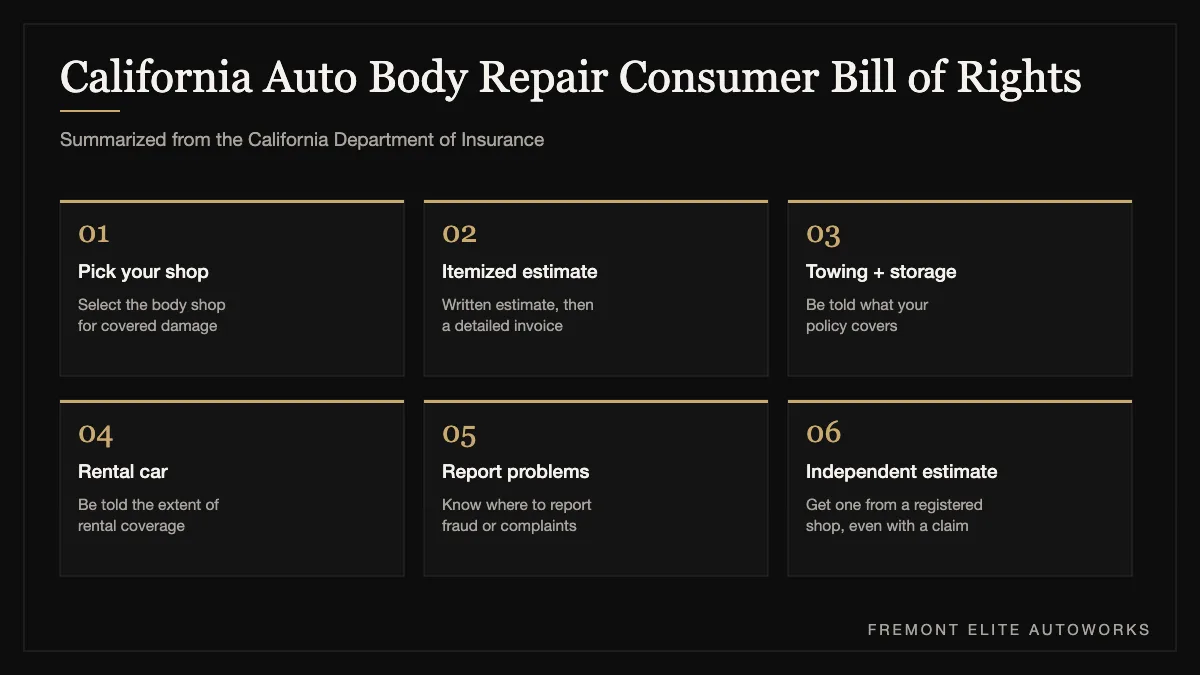
Ask your insurer two questions on that first call: what your policy covers for towing and storage, and what it covers for a rental car. California's Auto Body Repair Consumer Bill of Rights says you're entitled to be told both.
Rental cars while your car is in the shop
Most people need a car while theirs is being repaired, and this is where coverage details matter. If the other driver's insurer accepted fault, it usually covers a comparable rental for a reasonable repair period. If you're claiming on your own policy, rental coverage is an optional add-on with a daily limit and a maximum number of days, so check the numbers before you pick up the rental.
Two things help. First, confirm the rental is approved before you drive it off the lot, so you aren't billed personally. Second, choose a shop that sends supplements quickly, because rental coverage often runs out while a car waits on an approval. We keep adjusters updated so a delay on paper doesn't turn into a bill for you.
Your right to choose the body shop
This is the part most people don't know. In California, an insurer can't require you to use a particular shop. Under the state's fair claims regulations, an insurer may not suggest you move your car to a different shop after you've chosen one, except as the Insurance Code allows. The California Department of Insurance lists "select the auto body repair shop" as the first right in its consumer bill of rights.
Insurance companies often have "direct repair" networks and may offer to send you to one. That can be fine. It's your decision, though, and you can pick a shop you trust instead. We explain the rules, and what to say to an adjuster, in Can I choose my own body shop in California?
“It mostly comes down to the way you treat people and what kind of experience somebody has when they come in.”
JAZ, OWNER
Towing: where the car goes matters
If the car can't be driven, the tow is where people lose the most money without realizing it. A car towed to a storage yard can collect daily fees, and then it needs a second tow to the shop.
The cleaner path is to have it towed straight to the shop you've chosen. We provide towing after an accident. Call us at (510) 634-3433 and we'll arrange it and start the paperwork. California's claims rules also require insurers to pay reasonable towing and storage charges when they were needed to protect the vehicle. Our guide to towing after an accident in Fremont covers tow yards, storage fees and how to get your car released.
What happens at the body shop
A proper repair follows a predictable order. Here's how it runs at our shop.
1. Inspection and a written estimate
We inspect the car and write an itemized estimate. California's Bureau of Automotive Repair requires a written estimate before work starts, and your authorization before a shop goes over it. Our guide to how auto body estimates work in California explains every line.
2. Working with your adjuster
We send photos and the estimate to your insurer and deal with the adjuster directly. You don't have to be the go-between.
3. Teardown and supplements
Once panels come off, hidden damage often shows up: a cracked bracket, a bent reinforcement, a damaged sensor mount. That becomes a supplement, a documented addition the insurer reviews. Supplements are normal and don't mean the first estimate was wrong.
4. Structural and body repair
Frame and structure get measured against factory dimensions, then panels are repaired or replaced.
5. Paint and color matching
We match the color to your car as it looks today, not just the factory code, and blend it into the next panels so there's no visible edge. Here's why paint doesn't always match after a repair, and how we avoid it.
6. Scans, calibration and inspection
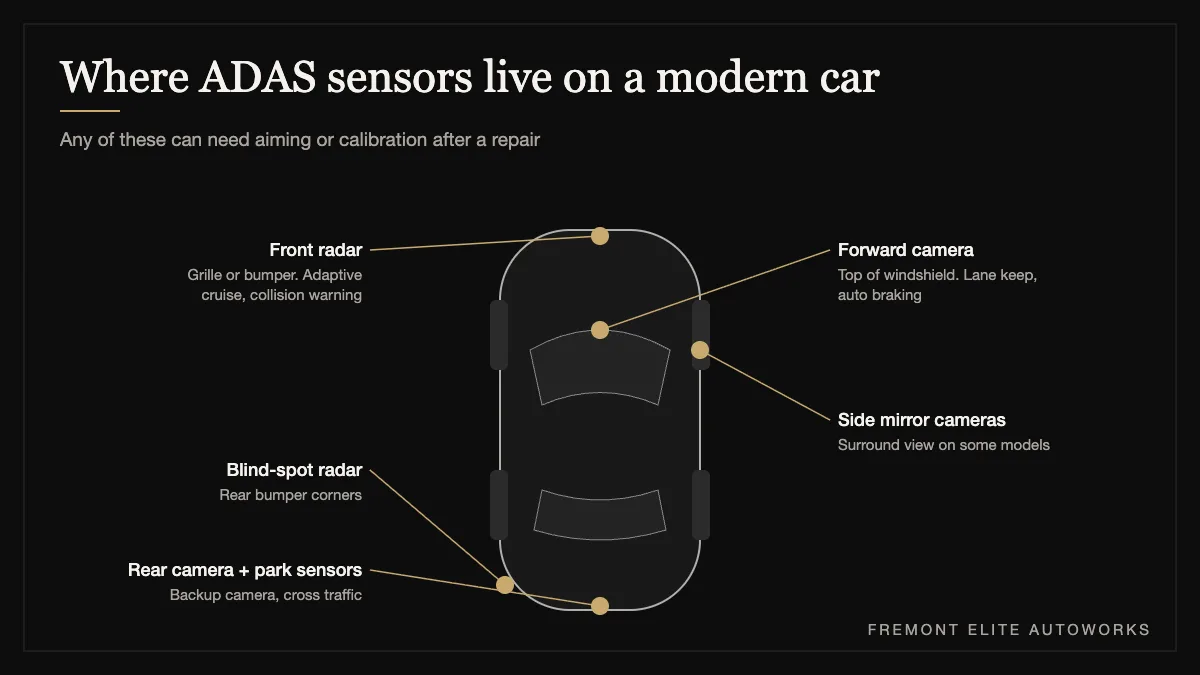
Modern cars need their safety systems checked after a collision. We do ADAS calibrations in house. Our ADAS calibration guide explains why skipping this step is a real safety risk.
7. Final check and delivery
Panel gaps, lights, paint under inspection lighting, a road test, then your keys.
Cars that need extra care
Some vehicles take more than a standard repair, and Fremont has a lot of them.
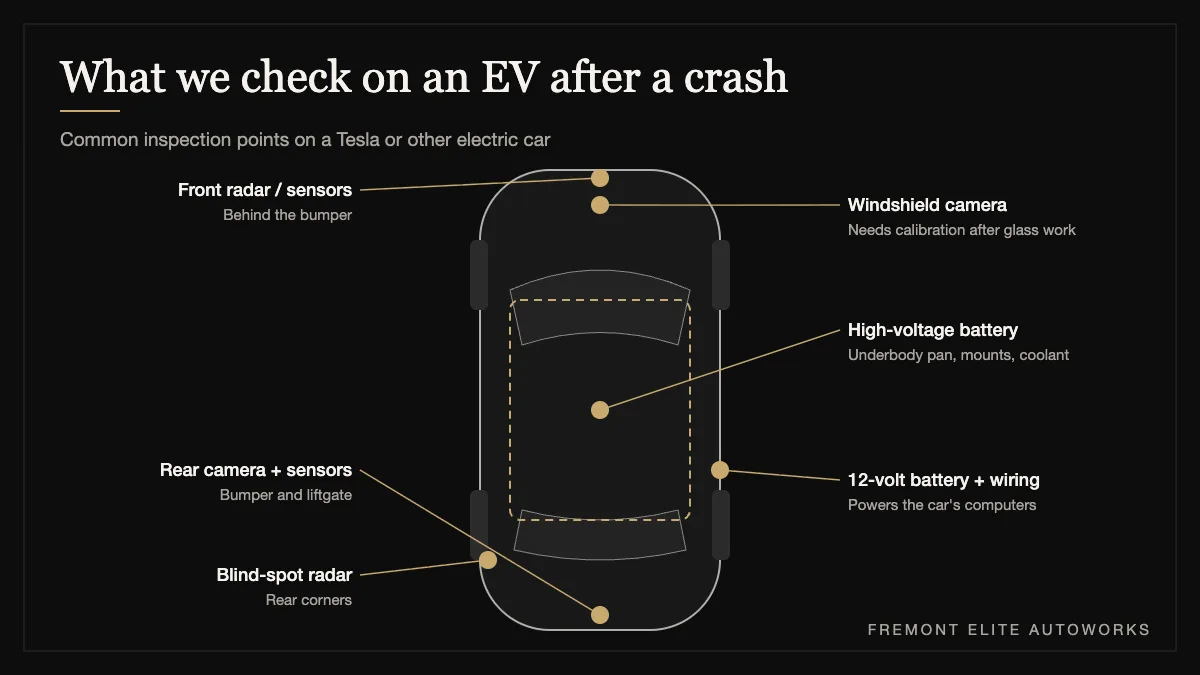
- Teslas and other EVs need high-voltage safety steps, battery inspection and camera calibration. See Tesla collision repair in Fremont.
- BMW, Mercedes-Benz and Porsche models call for factory repair procedures, specific materials and precise paint. We're certified for all three. Read European car collision repair in Fremont.
- Anything with a windshield camera needs calibration after glass replacement. See windshield replacement in Fremont.
- A front-end hit in summer often damages the A/C condenser behind the bumper. If your air blows warm after a repair, read why your car's AC isn't blowing cold.
How long does collision repair take in Fremont?
It depends on three things: how much damage there is, how fast parts arrive, and how quickly the insurer approves supplements. A bumper and paint job can take a few days. A structural repair with parts on backorder can take weeks.
What you can control: pick the shop early, have the car towed straight there, respond to your adjuster quickly, and ask the shop to send supplements the same day they find hidden damage. Customers often tell us our turnaround was faster than they expected. Our team regularly works late to finish repairs and meet customers at pickup.
Common mistakes after a Fremont car accident
- Letting the car sit at a storage yard. Storage fees can add up while the claim is pending.
- Accepting the first shop the insurer names without asking questions. You can pick your own.
- Skipping the photos. Memory fades, and photos settle disputes.
- Missing the SR-1 deadline. It's 10 days when it applies.
- Assuming the warning lights will go away. A lit ADAS or airbag light after a crash needs a scan.
- Signing a repair authorization you haven't read. Ask for the itemized estimate first.
Getting your car repaired in Fremont
- Get safe, document everything and open the claim the same day.
- You choose the body shop. Have the car towed straight there.
- Insist on an itemized written estimate, factory-correct repairs and safety-system calibration.
When you're ready, call (510) 634-3433 or request a free estimate. We'll arrange the tow if you need one, work with your insurance company, and give you a straight answer on what the repair involves.
Frequently asked questions
What should I do right after a car accident in Fremont?
Check for injuries and call 911 if anyone is hurt, move out of traffic if it's safe, and exchange names, license, insurance and plate details. Then photograph the scene and the damage and call your insurance company to open a claim.
Do I need to report a minor accident to the DMV in California?
You must file an SR-1 with the DMV within 10 days if anyone was injured or killed, or if property damage was over $1,000. Many small bumper repairs pass $1,000, so file it when in doubt.
Can my insurance company make me use its body shop?
No. California rules let you choose the auto body shop. Your insurer may suggest a shop from its network, but it can't require you to use it.
Who pays for towing after an accident?
It depends on your coverage and who was at fault. California's claims regulations require insurers to pay reasonable towing and storage charges when they were needed, so ask your adjuster what your policy covers.
How long does collision repair take?
Simple bumper and paint jobs can take a few days. Structural repairs, parts delays and supplement approvals can stretch it to a few weeks. Choosing the shop early and responding to your adjuster quickly helps the most.
Does Fremont Elite Autoworks work with my insurance company?
Yes. We work with all major insurance companies, coordinate directly with your adjuster, and handle the claim paperwork from the first photo to the final invoice.
Sources
- City of Fremont. Safety Data and Trends (2025).
- California DMV. Report of Traffic Accident Occurring in California (SR-1).
- California Department of Insurance. Auto Body Repair Consumer Bill of Rights.
- California Code of Regulations. 10 CCR 2695.8, Additional Standards Applicable to Automobile Insurance.

Owner-run auto body and collision shop at 41589 Albrae Street, Fremont, open since May 2023. Articles are reviewed by owner Jaz, who spent three and a half years at a dealership with its own body shop before opening the shop. Read our story. Related service: Collision Repair Experts.
Keep reading
 INSURANCE CLAIMSCan I Choose My Own Body Shop in California? Your Rights After a Fremont CrashWhat California law says about picking your repair shop, and the exact words to use with your adjuster.
 EV & TESLA REPAIRTesla Collision Repair in Fremont: What EV Owners Should KnowHow EV repairs differ from gas cars, and what to ask a shop before your Tesla goes in.
 SAFETY SYSTEMSADAS Calibration After a Collision: Why It Matters for Fremont DriversThe cameras and radar behind your safety features need to be re-aimed after many repairs. Here's when, and why.