KEY TAKEAWAYS
- European cars mix steel, aluminum and adhesives, and each needs a specific repair method.
- Factory procedures, structural measuring, scans and calibration are part of a correct repair.
- Manufacturer certification programs require equipment, training and genuine parts.
- Genuine parts matter most on structure, sensor brackets and adaptive headlamps.
- We're certified for Mercedes-Benz, BMW and Porsche collision repair.
European car collision repair means following the manufacturer's repair procedures step by step, because BMW, Mercedes-Benz and Porsche build their cars with mixed materials, precise structures and sensors that only work when everything sits in its factory position. A generic repair can look right and still change how the car protects you in the next crash.
European cars are what we specialize in at Fremont Elite Autoworks. We can repair any brand, but our heart is German cars, and we're certified for Mercedes-Benz, BMW and Porsche collision repair. Here's what that means and what to expect when your car comes in.
Why European cars need a procedure-first repair
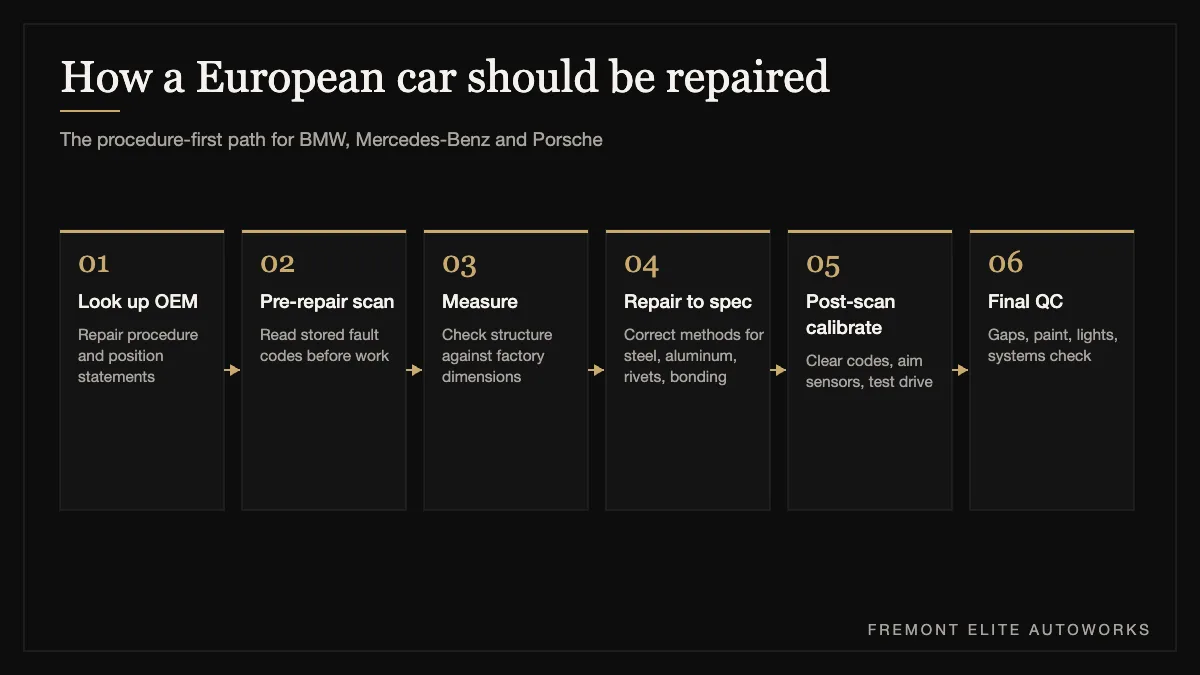
Mixed materials
Modern BMW, Mercedes-Benz and Porsche bodies combine high-strength steels, aluminum and sometimes carbon fiber. Each needs its own repair method. Aluminum can't be straightened or welded like mild steel, and many joints are designed for rivets and structural adhesive rather than welds. Using the wrong method can weaken the part.
Tight tolerances
These cars are built to precise dimensions. Panel gaps, suspension mounting points and sensor brackets all have to land exactly where the factory put them. That's why structure gets measured against factory data before and after the repair.
Sensors everywhere
Radar in the bumper, cameras in the windshield and mirrors, parking sensors, and on many models night vision and surround view. After a collision these systems need scans and calibration, and that work adds up: AAA's 2023 study found ADAS parts and calibration averaged 37.6% of repair costs across four common crash scenarios. We do calibrations in house. See our ADAS calibration guide.
What manufacturer certification means
Carmakers run certified collision repair programs. BMW's, for example, is its Certified Collision Repair Center network. Mercedes-Benz and Porsche have their own programs. Details vary, but they generally require specific equipment, trained technicians, access to factory repair information and the use of genuine parts, and they're checked by the manufacturer.
“We specialize in BMWs, Mercedes, and practically, if you want to look at the exact body work specialty that we do, we were phenomenal with paint matching.”
JAZ, OWNER
In Jaz's words, Porsche certification is "one of the hardest certificates to get." For you, certification means the shop has shown the manufacturer it can repair your car the way the factory designed it to be repaired.
Genuine parts versus aftermarket on European cars
For German cars, we push for genuine OEM parts, especially on:
- Structural parts and reinforcements, which are engineered for specific crash behavior.
- Bumper covers and brackets that carry sensors, since a bracket a few millimeters off throws off radar aim.
- Headlamps, many of which are adaptive units tied into the car's electronics.
If your insurer specifies non-OEM parts, California requires the insurer to warrant those parts match OEM in quality, safety, fit and performance, and to disclose it in writing. Our guide to how auto body estimates work in California explains how to push back.
Paint on BMW, Mercedes-Benz and Porsche
European colors are some of the hardest to match. Many are metallic or tri-coat, and German owners notice small differences. We read the actual color with a spectrophotometer, spray test cards, and blend into adjacent panels so the repair disappears. Here's why car paint doesn't match after a repair at shops that skip those steps.
Damage we see most on German cars
A few repairs come up again and again on the BMW, Mercedes-Benz and Porsche models that come through our shop.
- Front bumper hits with parking sensors and radar. Even a slow-speed bump in a parking lot can crack sensor brackets or push the radar out of alignment. The bumper looks fine; the adaptive cruise doesn't work.
- Aluminum hoods, fenders and doors. Many German models use aluminum outer panels to save weight. Dents in aluminum need different tools and a different technique than steel, and some damage means replacing the panel rather than repairing it.
- Adaptive and LED headlamps. These are expensive assemblies with their own control modules. A cracked lens or broken mounting tab often means a new unit, and it has to be coded to the car.
- Wheels and suspension after curb strikes. Low-profile tires don't absorb much. A curb hit can bend a wheel or a control arm and throw off the car's alignment, which some driver-assistance systems depend on. We subcontract wheel alignment to a trusted alignment company, then check the systems that rely on it.
Protecting your car's resale value
Collision repairs often show up on vehicle history reports once an insurance claim is filed. When you sell or trade in a European car, a buyer or dealer may inspect the repaired area closely, measure paint thickness and check panel gaps. A repair done to factory procedures, with genuine parts and a paint match that disappears, is what keeps that inspection from knocking thousands off the price. Keep the final invoice and any calibration reports. They're proof the repair was done correctly.
Fremont, the Peninsula and the South Bay
Fremont sits between Silicon Valley and the East Bay, and a lot of German cars commute through here on I-880, I-680 and the Dumbarton Bridge. Many customers are used to dealership service and want that level of care without the dealership experience.
That's personal for Jaz. Before opening the shop, he spent about three and a half years at a Chrysler Dodge Jeep Ram dealership that had its own body shop, and he studied how that body shop worked. What he took from it: the equipment matters, but what people remember is how they were treated. Read his full story.
Teslas and other EVs
Teslas share a lot with modern European cars: aluminum structures, bonding, sensors and precise calibration, plus a high-voltage battery. If you drive one, read our guide to Tesla collision repair in Fremont.
Questions to ask about your European car's repair
- Are you certified by my car's manufacturer?
- Will you follow the factory repair procedures and position statements?
- Will you do a pre-repair and post-repair scan, and calibrate the sensors?
- Will you use genuine parts on structural and sensor-related repairs?
- How do you match metallic and tri-coat colors?
- What's your warranty? Ours is a lifetime guarantee on workmanship.
For everything that happens after an accident, from the tow to the final inspection, see our complete guide to a car accident in Fremont.
Getting your European car repaired in Fremont
- BMW, Mercedes-Benz and Porsche need procedure-first repairs because of mixed materials, tight tolerances and sensors.
- Manufacturer certification means the shop meets the brand's equipment, training and parts requirements.
- Genuine parts and a careful color match protect the car's safety and its value.
Call (510) 634-3433 or request a free estimate. We work with all major insurance companies.
Frequently asked questions
Do I need a certified body shop for my BMW or Mercedes-Benz?
It isn't legally required, but a manufacturer-certified shop has shown it has the equipment, training and repair information the brand requires. California lets you choose any registered shop.
Why is European car collision repair more expensive?
Mixed materials, genuine parts, sensor calibration and factory-required procedures add time and cost, but they protect the car's safety and resale value.
Can aluminum body panels be repaired?
Some can, with aluminum-specific tools and methods. Others must be replaced, depending on the damage and the manufacturer's procedures.
Will my insurance pay for OEM parts on my Mercedes-Benz?
It depends on your policy. If your insurer specifies non-OEM parts, California requires it to warrant they match OEM parts and disclose it in writing.
Is Fremont Elite Autoworks certified for Porsche?
Yes. We're certified for Mercedes-Benz, BMW and Porsche collision repair, and we repair all other makes too.
Sources
- BMW of North America. BMW Certified Collision Repair Centers.
- AAA. Cost of ADAS Repairs (December 2023).
- California Code of Regulations. 10 CCR 2695.8(g), Non-OEM Replacement Crash Parts.

Owner-run auto body and collision shop at 41589 Albrae Street, Fremont, open since May 2023. Articles are reviewed by owner Jaz, who spent three and a half years at a dealership with its own body shop before opening the shop. Read our story. Related service: Precision Paint & Color Match.
Keep reading
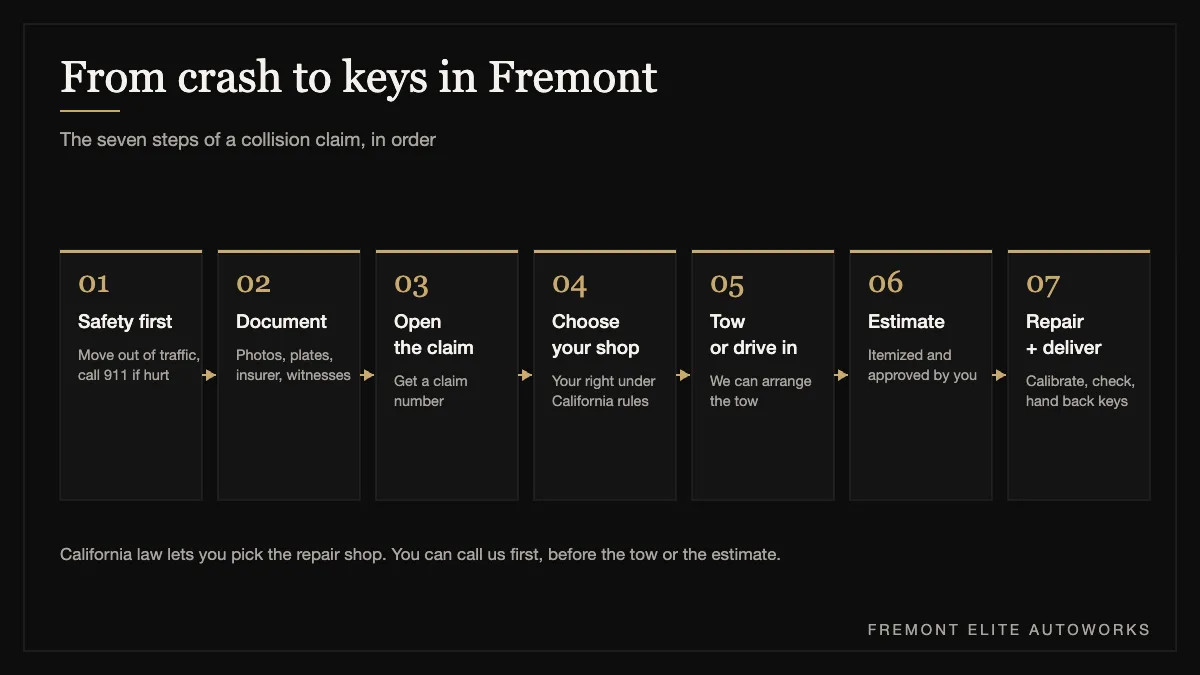 THE FREMONT COLLISION GUIDEWhat to Do After a Car Accident in Fremont: The Complete Repair GuideEvery step from the crash scene to getting your keys back, written by the shop that handles Fremont claims every week.
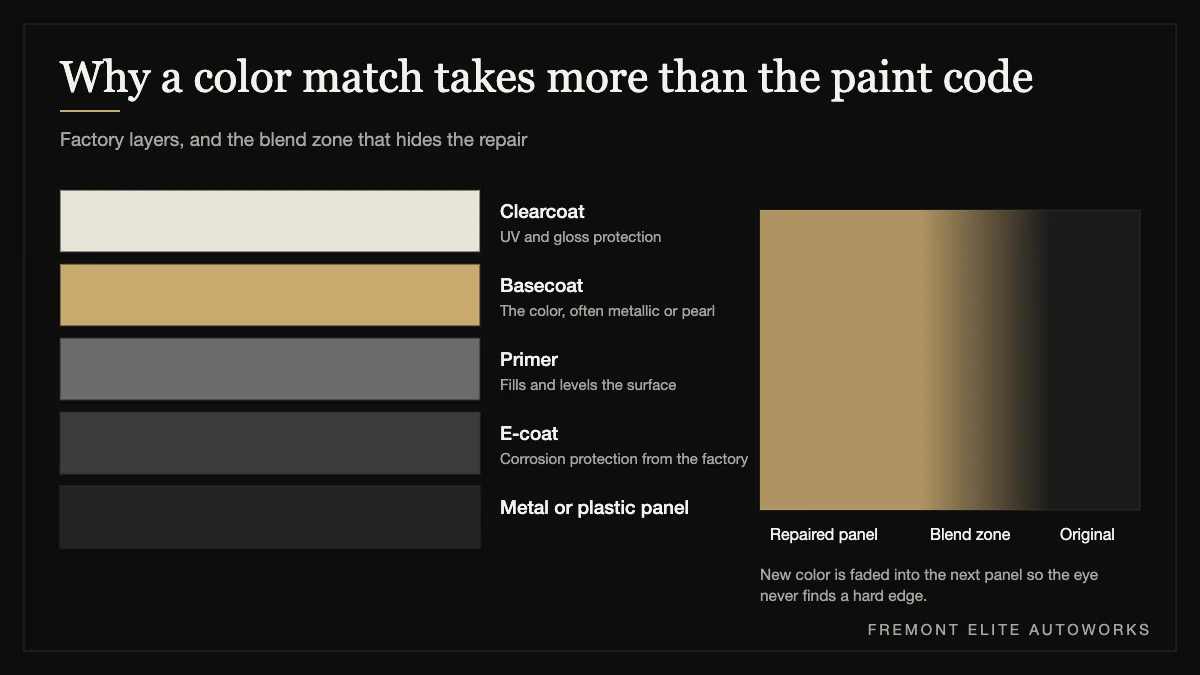 PAINT & COLORWhy Car Paint Doesn't Match After a Repair, and How to Get a Perfect MatchThe paint code is only the starting point. Here's why mismatches happen and how a proper match is made.
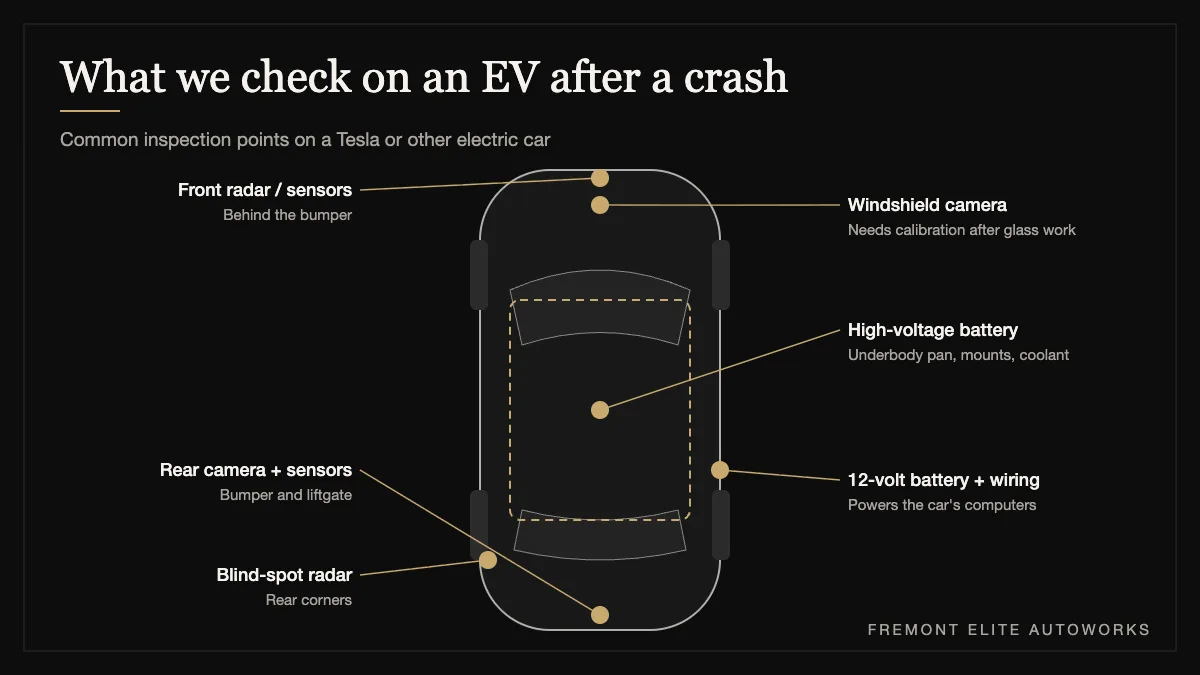 EV & TESLA REPAIRTesla Collision Repair in Fremont: What EV Owners Should KnowHow EV repairs differ from gas cars, and what to ask a shop before your Tesla goes in.