KEY TAKEAWAYS
- EV repairs need high-voltage safety steps, underbody battery inspection and heat-aware painting.
- Tesla cameras must be checked and calibrated after a collision or windshield replacement.
- AAA found ADAS work averaged 37.6% of repair cost across four common crash scenarios.
- You can use any shop you trust. California law lets you choose.
- Choosing the shop early is the most effective way to shorten parts delays.
Tesla collision repair in Fremont follows the same basic steps as any body repair, with extra work around three things: the high-voltage battery, the cameras that drive Autopilot and safety features, and parts that often come only from Tesla. A shop needs EV tools, training on high-voltage safety and a plan for calibration before it starts.
Fremont is Tesla's hometown. Model 3 and Model Y are built at the Fremont factory, and it shows on Stevenson Boulevard, on I-880 and in the parking lots at Pacific Commons. So we see a lot of Teslas at our shop on Albrae Street, and a lot of owners asking the same questions after a crash. Here are the answers.
Why Fremont has so many Teslas to repair
Tesla's Fremont factory, a short drive from our shop, is the company's highest-output plant in North America. In January 2026, CBS San Francisco reported that Tesla would wind down Model S and Model X production at the plant and turn that space over to its Optimus robots, while Model 3 and Model Y production continues and makes up most of the factory's output.
For owners, that has two practical effects. Model 3 and Model Y parts and know-how stay common locally. And Model S and Model X owners should plan ahead, since parts for discontinued models can take longer to source over time. Either way, a crash in a Tesla means you need a shop that knows EVs.
How EV collision repair is different
The high-voltage battery
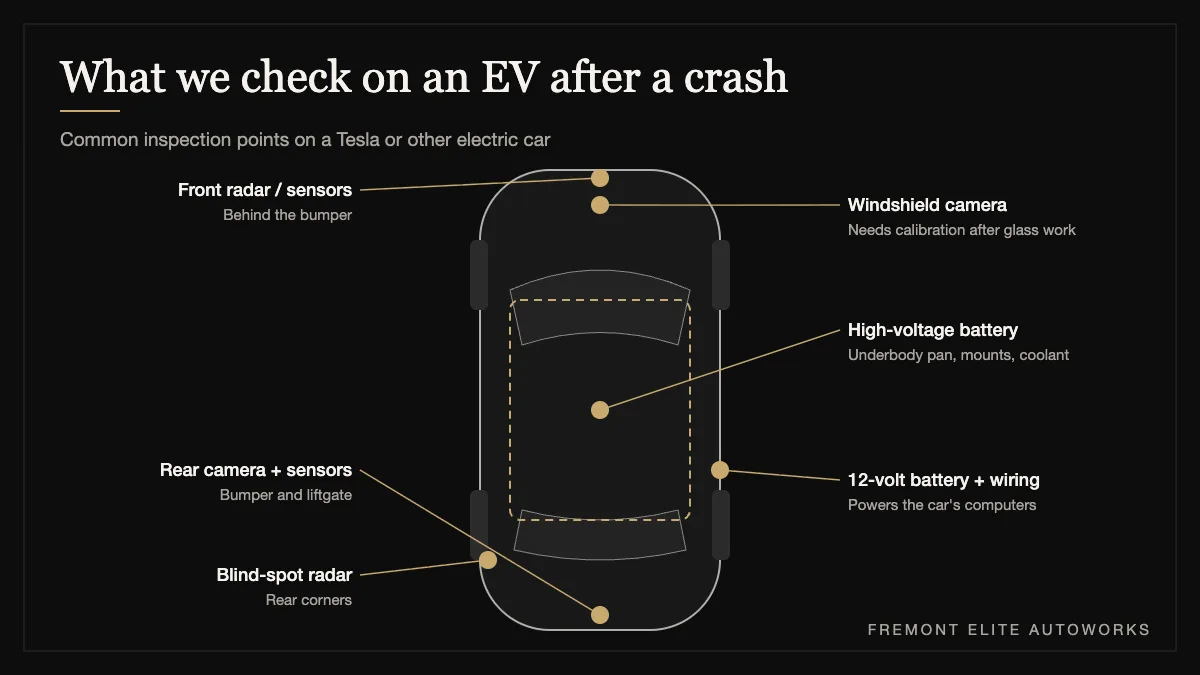
The battery pack sits under the floor and covers most of the car's footprint. After a collision, the underbody has to be inspected for impact damage, coolant leaks and damage to mounting points. Before certain repairs, the high-voltage system has to be disabled following the manufacturer's procedure, and technicians use insulated tools and protective gear. We have EV tools in the shop for this work.
Heat and paint booths
Paint is cured with heat. EV makers publish limits on how much heat the battery pack should see, which affects how the car is handled in the paint booth. A shop that doesn't account for this can put the battery at risk.
Structure and materials
Teslas use large cast aluminum sections and a mix of high-strength steel and aluminum. Repairs that would be routine on an older car may call for replacing a whole section, or for bonding and rivets instead of welding. That's why following the manufacturer's repair procedures matters so much.
Glass roofs
The Model 3 and Model Y have large glass roofs. A side or rollover impact can crack the glass, and the roof glass is part of how the body carries loads.
Cameras, sensors and calibration
Teslas rely on cameras for Autopilot, lane departure warnings, automatic emergency braking and parking features. The forward cameras sit behind the windshield, and more cameras live in the side repeaters, pillars and rear.
After a collision or windshield replacement, those cameras have to be checked and calibrated. AAA's research found that driver-assistance systems add real cost to repairs. In its 2023 study, ADAS parts and calibration made up an average of 37.6% of the repair bill across four common crash scenarios. It isn't a step to skip. We explain the process in our ADAS calibration guide.
“We do ADAS calibrations, and we do have EV tools as well.”
JAZ, OWNER
Tesla parts and repair times
Tesla supplies most structural and body parts for its cars. Delays usually come from parts availability, not labor. What helps:
- Choose the shop early so parts are ordered right after the teardown.
- Approve supplements quickly if you're paying, or ask your adjuster to.
- Keep your Tesla app handy. It can help with key cards, service mode and vehicle status.
Tesla also runs its own approved body shop network. You can use one of those shops, or any shop you trust. California law lets you choose, and we explain that in Can I choose my own body shop in California?
Insurance claims on a Tesla
EV repairs usually cost more than comparable gas-car repairs, largely because of the sensors, specialized parts and the extra steps around the battery. A few things to know:
- Tell your adjuster it's an EV and ask whether an in-person inspection is needed before teardown.
- Ask for OEM parts on structural and sensor-related repairs.
- Expect supplements. Hidden damage around the battery, cameras and brackets often shows up after disassembly.
- Paint on Teslas can be multi-stage, and some colors are hard to match. Here's why paint doesn't always match after a repair.
Summer driving, A/C and EVs
Many EVs use a heat pump for climate control, and the system also helps manage battery temperature. A front-end hit can damage the condenser and lines behind the bumper, and on an EV that affects more than cabin comfort. If your A/C isn't blowing cold after a repair, or ever, read why your car's AC isn't blowing cold in Fremont.
What to ask a shop before your Tesla goes in
- Do you have EV tools and a high-voltage safety process?
- Will you follow Tesla's published repair procedures?
- Will you scan the car and calibrate the cameras after the repair?
- How do you handle battery heat in the paint booth?
- Will you work with my insurance company directly?
- What's your warranty? Ours is a lifetime guarantee on workmanship.
For the whole process after a crash, start with our complete guide to a car accident in Fremont. For BMW, Mercedes-Benz and Porsche owners, see our guide to European car collision repair.
Getting your Tesla repaired in Fremont
- EV repairs add high-voltage safety steps, battery inspection and camera calibration.
- Model 3 and Model Y are built in Fremont. Model S and X production is winding down.
- Choose the shop early to get parts ordered, and ask for OEM parts on structural work.
Call (510) 634-3433 or request a free estimate. We'll handle the claim, the calibration and the paint match.
Frequently asked questions
Do I have to take my Tesla to a Tesla-approved body shop?
No. California lets you choose any registered body shop, even on an insurance claim. Pick one with EV tools, high-voltage safety procedures and calibration capability.
Why does Tesla collision repair take so long?
Most delays come from parts availability and supplement approvals. Choosing a shop early and approving supplements quickly shortens the wait.
Does a Tesla need camera calibration after a collision?
Often, yes. Cameras and sensors near the damage, and the forward cameras after windshield replacement, need to be checked and calibrated so safety features work correctly.
Can a body shop damage a Tesla battery?
It can if high-voltage procedures and heat limits aren't followed. A qualified shop disables the system when required, inspects the pack and manages heat during paint curing.
Does Fremont Elite Autoworks repair Teslas?
Yes. We repair Teslas and other EVs, have EV tools in the shop, do ADAS calibrations and work directly with your insurance company.
Sources
- CBS San Francisco. Tesla will end Model S and X production, focus on humanoid robots at Bay Area factory (January 29, 2026).
- AAA. Cost of ADAS Repairs (December 2023).
- California Code of Regulations. 10 CCR 2695.8, Additional Standards Applicable to Automobile Insurance.

Owner-run auto body and collision shop at 41589 Albrae Street, Fremont, open since May 2023. Articles are reviewed by owner Jaz, who spent three and a half years at a dealership with its own body shop before opening the shop. Read our story. Related service: Collision Repair Experts.
Keep reading
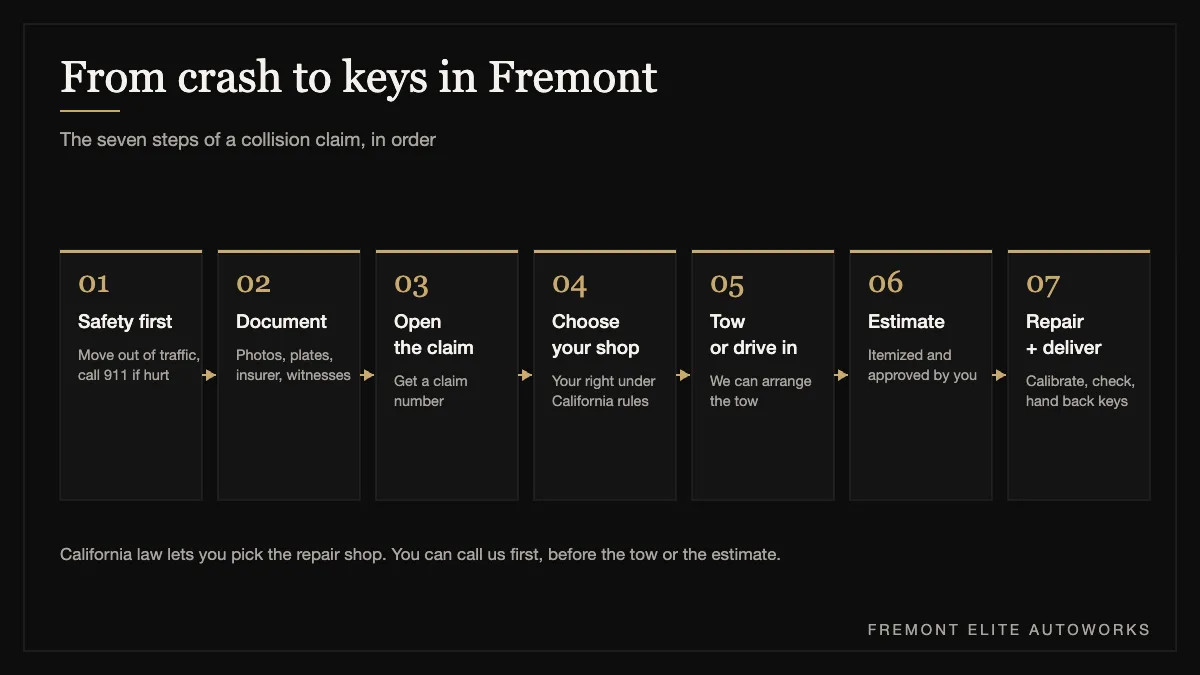 THE FREMONT COLLISION GUIDEWhat to Do After a Car Accident in Fremont: The Complete Repair GuideEvery step from the crash scene to getting your keys back, written by the shop that handles Fremont claims every week.
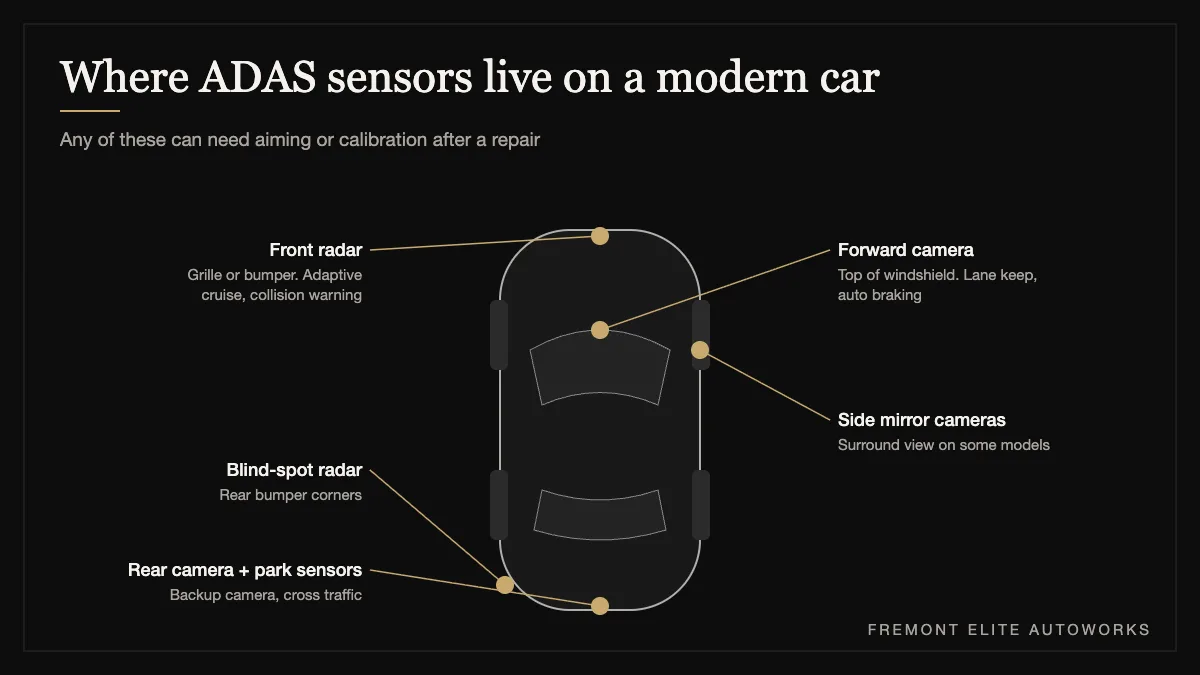 SAFETY SYSTEMSADAS Calibration After a Collision: Why It Matters for Fremont DriversThe cameras and radar behind your safety features need to be re-aimed after many repairs. Here's when, and why.
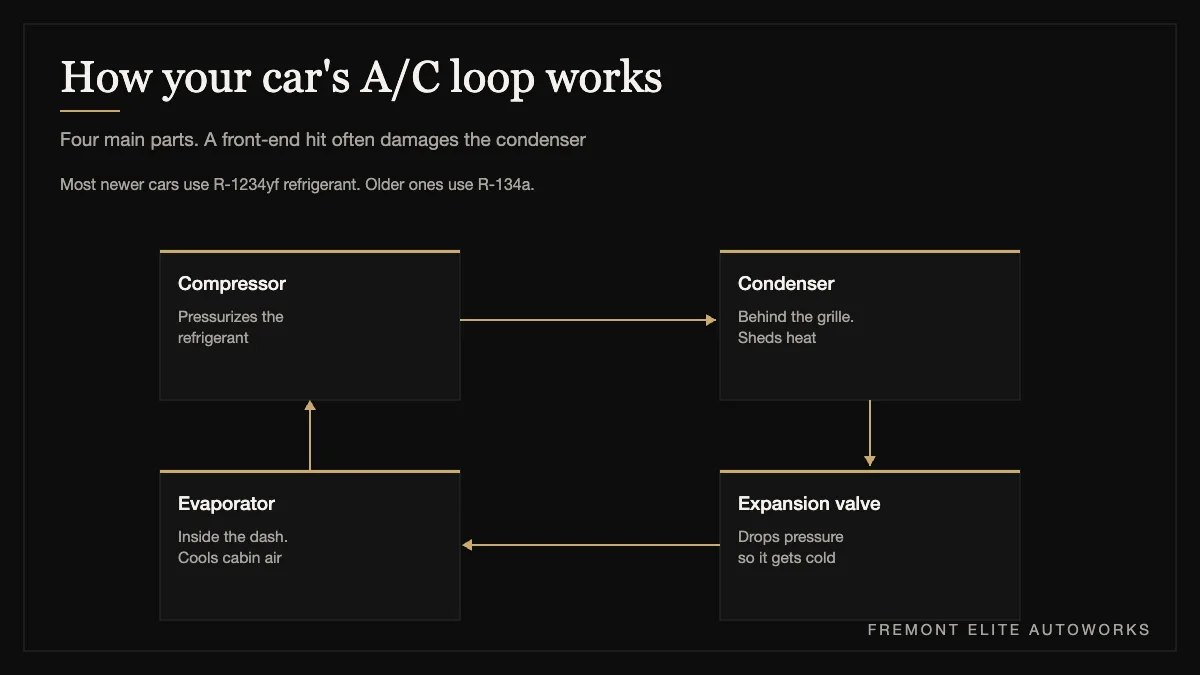 A/C REPAIRCar AC Not Blowing Cold in Fremont? Causes, Fixes and What It CostsWhy your car's air conditioning quit, what you can check yourself, and why a recharge alone rarely fixes it.