KEY TAKEAWAYS
- California requires a written estimate before work and your approval before it's exceeded.
- Every part on the estimate should be labeled OEM, aftermarket, used or reconditioned.
- Labor is billed in hours by type: body, structural, refinish, mechanical and calibration.
- Supplements for hidden damage are a normal part of collision repair.
- A lump-sum estimate or an offer to waive your deductible are red flags.
An auto body estimate in California is a written, itemized list of the parts, labor, paint and outside services needed to fix your car. The law requires one before work begins, it must say what kind of parts are being used, and the shop needs your approval before it goes over the amount.
Most people see an estimate for the first time right after an accident, when they least want to read a long document. This guide explains each section the way we'd explain it at the counter in Fremont, so you know what you're approving and why the number can change once the repair starts.
The rules behind every California repair estimate
California regulates this closely, which works in your favor.
- A written estimate is required. The Bureau of Automotive Repair's regulation, 16 CCR 3353, requires a written estimate for parts and labor before work starts. The shop can't go over it without your authorization.
- You can get an itemized estimate and invoice. The Department of Insurance's Auto Body Repair Consumer Bill of Rights says you're entitled to an itemized written estimate and, when repairs are done, a detailed invoice that lists parts and labor and identifies each part type.
- Insurers must share their estimate. Under 10 CCR 2695.8, an insurer has to give you a copy of its estimate, and that estimate must allow repairs to accepted trade standards.
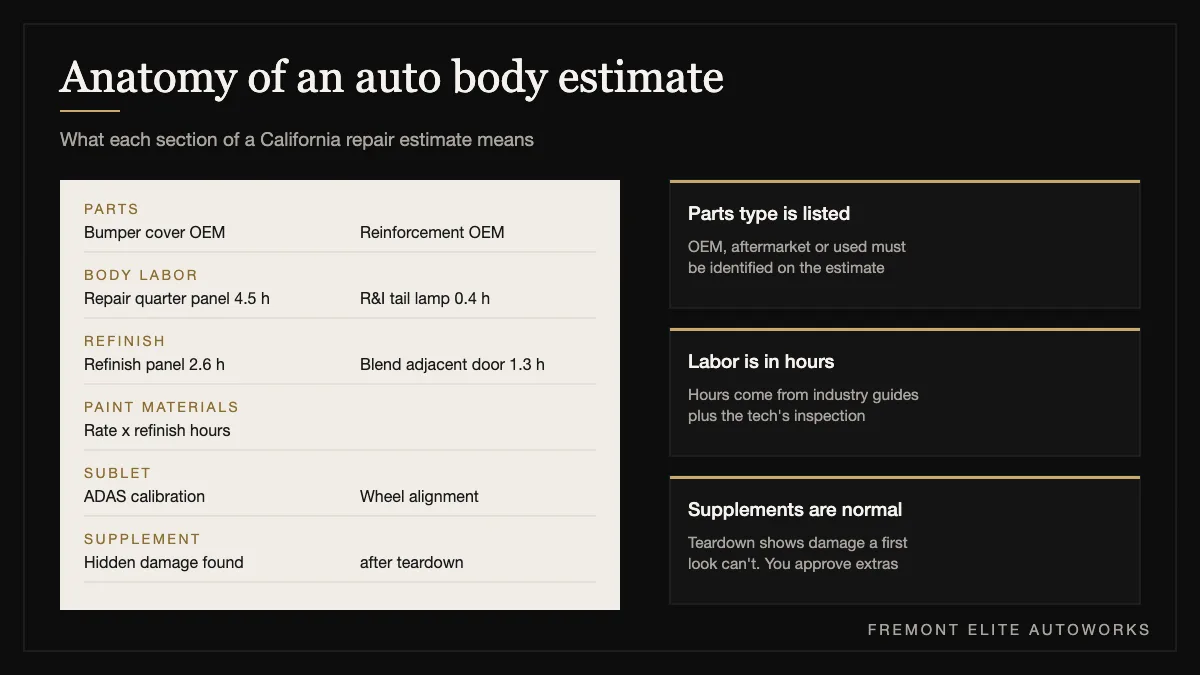
Parts: OEM, aftermarket and used
The parts section lists every piece being replaced. Each part should be labeled by type:
- OEM (original equipment manufacturer): made by or for the carmaker, the same as what came on your car.
- Aftermarket (non-OEM): made by another company to fit your car. It can cost less, but fit and finish vary.
- Used or recycled: a genuine part taken from another vehicle.
- Reconditioned: an original part, like a wheel or bumper, repaired for reuse.
California adds a protection here. If an insurer specifies non-OEM crash parts, the regulations require the insurer to warrant that they're at least equal to OEM in kind, quality, safety, fit and performance, and to disclose that in writing on the estimate. If a non-OEM part doesn't fit right, the insurer covers the cost of making it work.
For European cars, EVs and anything with driver-assistance sensors mounted behind the bumper, we usually push for OEM parts, because brackets and sensor mounts have to sit exactly where the carmaker designed them. We explain why in our guide to European car collision repair.
Labor hours and what they mean
Labor is listed in hours, not dollars, and then multiplied by the shop's labor rate. You'll usually see several labor types:
| Labor type | What it covers |
|---|---|
| Body labor | Removing, repairing and installing panels and parts |
| Structural or frame labor | Measuring and straightening the vehicle's structure |
| Refinish labor | Prepping, painting and clearcoating panels |
| Mechanical labor | Suspension, cooling or A/C parts damaged in the crash |
| Diagnostic and calibration | Pre-repair and post-repair scans, sensor aiming |
The hours come from industry estimating guides, adjusted for what the technician actually finds. A dented quarter panel might be listed as a repair of so many hours instead of a replacement, since quarter panels are welded to the body and replacing one is a major job.
Paint and materials
Two lines cover paint. Refinish labor is the time spent painting. Paint materials covers the paint, clearcoat, primer, sandpaper and masking, usually calculated from the refinish hours.
You'll often see a line to blend an undamaged panel next to the repaired one. That isn't padding. Blending fades the new color into the neighboring panel so your eye never catches an edge. Our article on why car paint doesn't match after a repair shows how it works.
Sublet: work sent outside the shop
"Sublet" means work done by a specialist and billed through the shop. Common examples:
- Wheel alignment after suspension or wheel damage. We subcontract alignment to a partner company.
- ADAS calibration, when a shop doesn't do it in house. We do calibrations ourselves. See our ADAS calibration guide.
- Glass, which our sister auto glass company handles with its own certified technicians.
- Towing and storage charges, if they're being paid through the repair.
Why supplements happen
Almost every serious collision repair gets at least one supplement. The first estimate is written from what can be seen with the panels on. Once the bumper cover, lamps and liners come off, the shop finds what was hidden: a cracked absorber, a bent reinforcement bar, a broken sensor bracket, a pushed-in radiator support.
The shop documents it with photos and sends a supplement to the insurer. The insurer reviews it and approves it, sometimes after an in-person inspection. Then the repair continues.
A supplement doesn't mean the first estimate was wrong or that someone is padding the bill. It's how the process is designed. What matters is speed: a shop that sends supplements the same day it finds the damage keeps your repair moving.
Your deductible and who pays what
If you're claiming on your own collision coverage, you pay your deductible to the shop when you pick up the car, and the insurer pays the rest. If the other driver's insurer accepted liability, there's usually no deductible for you. If you're paying out of pocket, the estimate is your quote. Ask us about options for keeping the cost down, such as repairing a panel instead of replacing it where that's safe.
Estimate red flags to watch for
- A lump-sum number with no itemization. You're entitled to an itemized estimate.
- No part types listed. Every part should say OEM, aftermarket, used or reconditioned.
- No scan or calibration on a car with driver-assistance features, after front or rear damage or glass work.
- "We'll waive your deductible." A shop offering to absorb your deductible by inflating the bill to the insurer is a warning sign.
- Pressure to sign today. A good shop will explain the estimate and give you time.
If your car was towed and storage is on the bill, our guide to towing after an accident explains what insurers are required to pay. If you're not sure whether you can take your estimate to a different shop, read Can I choose my own body shop in California? And for every step from crash to keys, see our complete Fremont car accident guide.
Getting a clear estimate in Fremont
- A California estimate must be written, itemized and approved by you before extra work.
- Part types must be listed, and non-OEM parts specified by an insurer come with a written warranty.
- Supplements are normal. Fast documentation keeps your repair on schedule.
Bring the car to 41589 Albrae Street, call (510) 634-3433, or request a free estimate. We'll walk you through every line before any work starts.
Frequently asked questions
Is a body shop estimate free in Fremont?
At Fremont Elite Autoworks, collision estimates are free. Call (510) 634-3433 or request one online.
Why did my repair cost more than the first estimate?
Most often because hidden damage was found after the panels came off. The shop documents it as a supplement, and the insurer reviews it. In California, a shop needs your authorization before going over the written estimate.
Do I have to use aftermarket parts if my insurer says so?
An insurer can specify non-OEM parts, but California requires it to warrant they match OEM parts in quality, safety and fit, and to disclose that in writing. Talk to your shop and adjuster if you want OEM parts.
What does blend mean on an estimate?
Blending means painting part of the undamaged panel next to the repair so the new color fades in without a visible edge. It's standard practice for a good color match.
What is sublet on a repair estimate?
Sublet is work a specialist does and the shop bills for, such as wheel alignment, glass replacement or sensor calibration.
Sources
- California Code of Regulations. 16 CCR 3353, Written Estimate Required for Repair or Maintenance.
- California Department of Insurance. Auto Body Repair Consumer Bill of Rights.
- California Code of Regulations. 10 CCR 2695.8, Additional Standards Applicable to Automobile Insurance.

Owner-run auto body and collision shop at 41589 Albrae Street, Fremont, open since May 2023. Articles are reviewed by owner Jaz, who spent three and a half years at a dealership with its own body shop before opening the shop. Read our story. Related service: Collision Repair Experts.
Keep reading
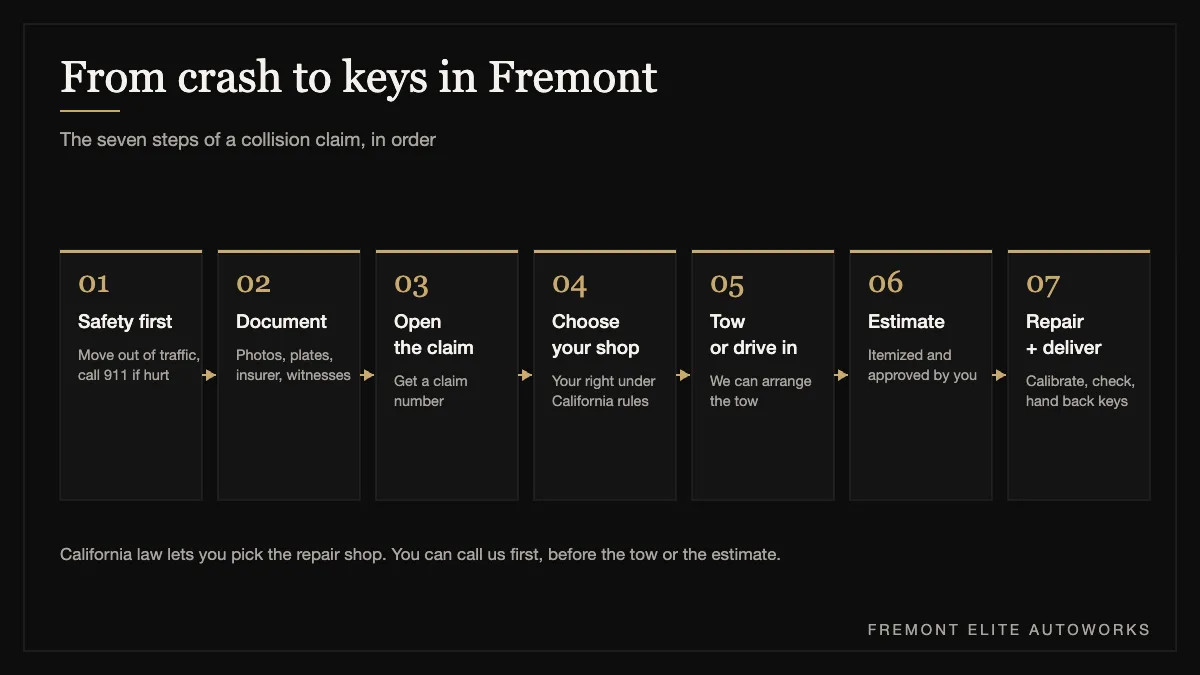 THE FREMONT COLLISION GUIDEWhat to Do After a Car Accident in Fremont: The Complete Repair GuideEvery step from the crash scene to getting your keys back, written by the shop that handles Fremont claims every week.
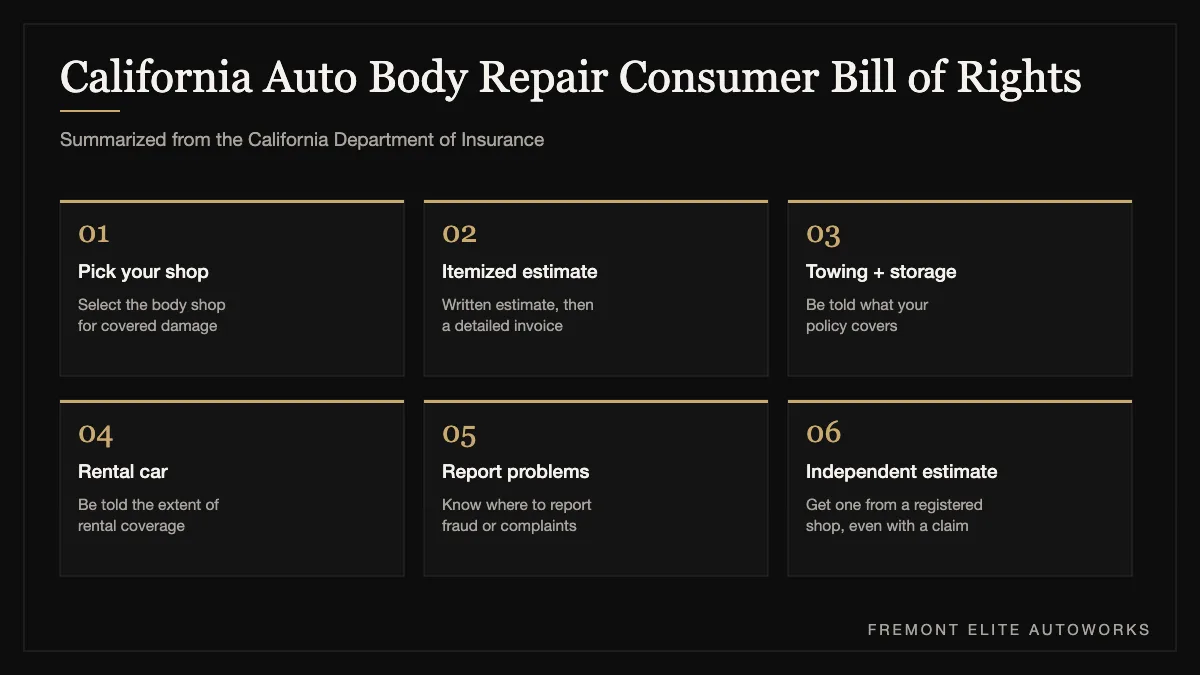 INSURANCE CLAIMSCan I Choose My Own Body Shop in California? Your Rights After a Fremont CrashWhat California law says about picking your repair shop, and the exact words to use with your adjuster.
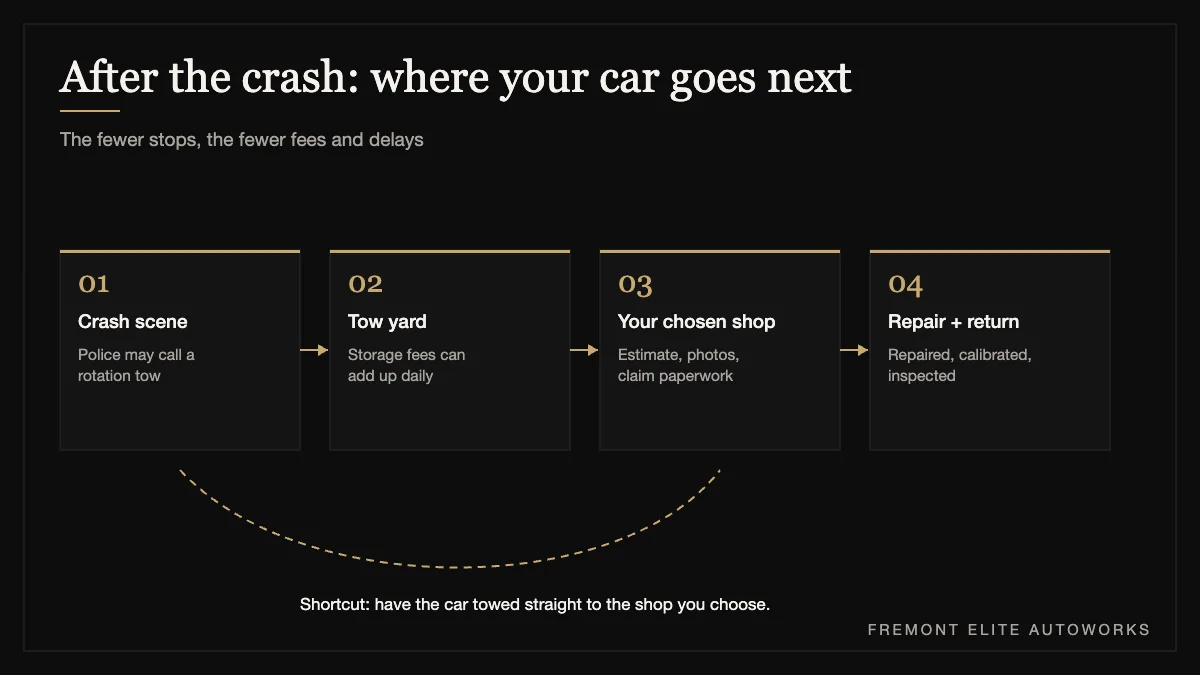 TOWING & STORAGETowing After an Accident in Fremont: Tow Yards, Storage Fees and Getting Your Car BackWhere your car should go after a crash, how to stop storage fees, and what your insurer is required to pay.