
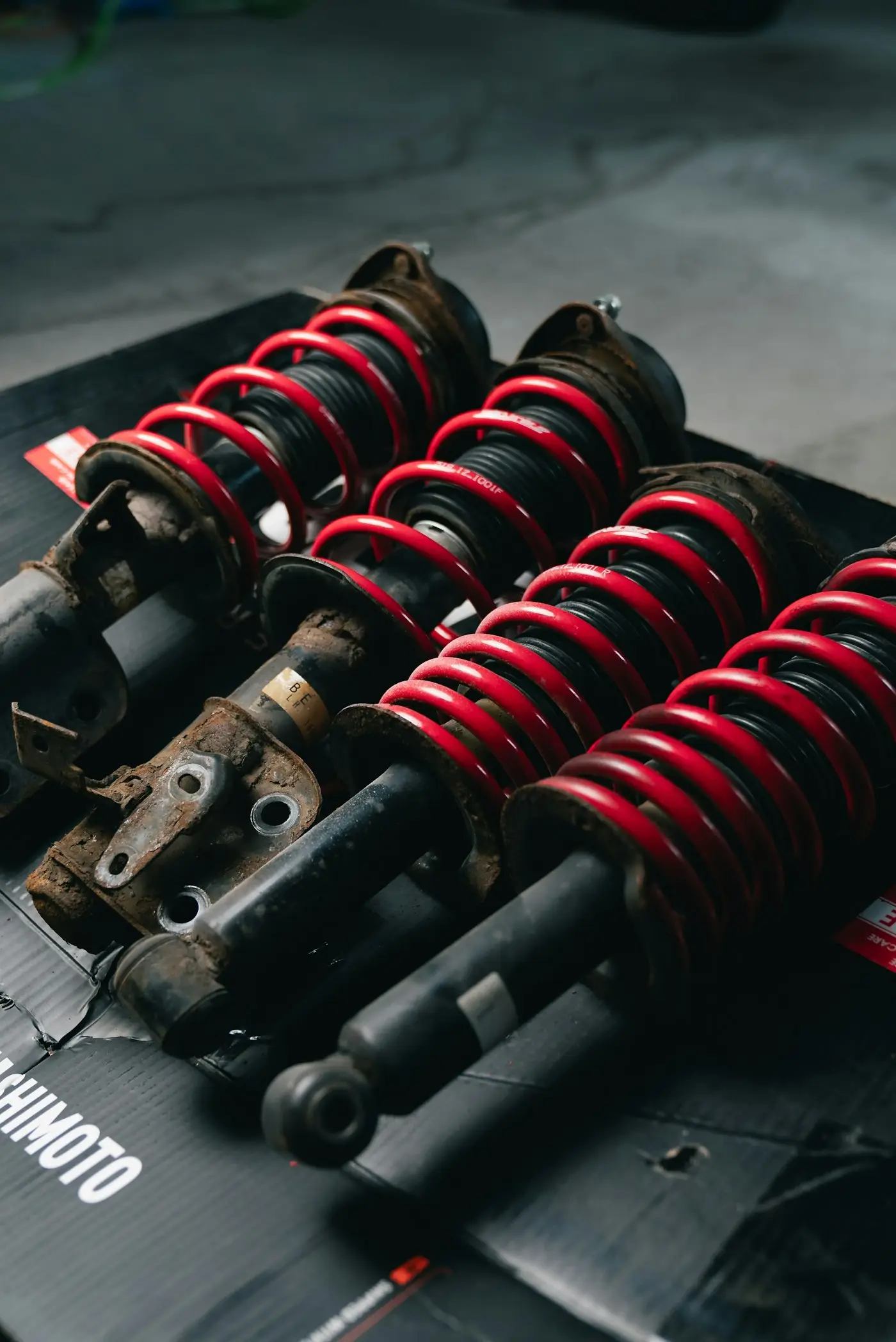
Shocks and struts do not fail all at once. They fade, a little at a time, until a bouncy ride, a nose that dives hard under braking, or oddly worn tires start to feel normal. That gradual decline is exactly why so many drivers do not notice a problem until it is well developed, sometimes not until a passenger mentions the ride feels different, or a tire shop points out a wear pattern that should not be there. Here are six signs worth paying attention to, and how we confirm which one applies before recommending a repair, since more than one of these can show up together once a vehicle has gone a while without a check.
- Shocks and struts control how the suspension settles, so symptoms show up as motion, not noise, which is why they get missed.
- A bounce test and a visual check for fluid leaks are quick ways to get a first read before a full inspection.
- Cupped or scalloped tire wear is one of the more reliable visible signs of worn shocks or struts.
- Speed humps and the rougher stretches near the port wear these parts out faster than a typical suburban commute would.
- We check all four corners together, since these parts tend to wear in a related pattern rather than one at a time.
1. A bouncy, floaty ride
Push down firmly on a front corner of the car and let go. A healthy shock or strut will settle back to rest within a bounce or two. If the car keeps bouncing two, three or more times, the shock has lost its ability to control the spring's motion, even though the spring itself is probably fine. This simple test is a reasonable first check you can do in your own driveway before calling us.
The reason this matters beyond comfort is control. A suspension that cannot settle quickly keeps the tire bouncing slightly off the road surface for longer after every bump, which reduces the contact patch available for braking and cornering right when you might need it most, not just on a rough road but on an otherwise ordinary drive.
2. The nose dives hard when you brake
Some forward weight transfer under braking is normal. A pronounced, exaggerated dive, where the front end drops noticeably more than it used to, usually means the front shocks or struts are no longer damping that motion the way they should, which also extends your actual stopping distance slightly since the front tires are not staying as evenly loaded through the stop.
Drivers sometimes describe this as the car feeling like it is "falling into" a hard stop rather than settling into it smoothly. If that description sounds familiar, it is worth a check even if nothing else on this list feels obviously wrong yet.
3. Bouncing after dips or speed humps
If the car continues to bounce or feels unsettled for a beat or two after a dip or speed hump, rather than absorbing it in one smooth motion, that is a classic symptom of worn damping. West Long Beach's side streets have a fair number of speed humps, and this is one of the more common complaints we hear from drivers who live or work near them, since the repeated, predictable impact makes the symptom easy to notice on a familiar route.
4. Clunking or knocking over bumps
A clunk is usually a different part than a bounce, often a strut mount, sway bar link or a worn bushing rather than the shock or strut itself, but the two commonly wear out around the same time since they absorb the same road impacts. We check all of it on the lift rather than guessing from the sound alone. See our dedicated guide to clunking noises for more on isolating this specific symptom and the four parts most likely to be responsible.
5. Cupped or scalloped tire wear
Worn shocks and struts let the tire bounce slightly off the road surface at speed instead of staying planted, and that intermittent contact wears the tread in a wavy, scalloped pattern rather than evenly. If you run your hand across the tread and feel a rhythmic up-and-down pattern, that is cupping, and it is one of the more reliable visual signs that damping has failed, separate from an alignment issue, which tends to produce a more even edge-to-edge wear pattern instead.
Cupping is also one of the harder wear patterns to reverse once it sets in, since the tire's surface itself has developed an irregular profile. Catching it early, while it is still mild, gives the new shocks or struts a better chance of stopping further damage before the tire needs replacing altogether.
6. Visible fluid leaking near the shock or strut
Hydraulic shocks and struts use fluid internally, and once that fluid starts leaking past the seal, the part has lost its ability to damp motion correctly, even if it still looks intact. A wet, oily residue on the shock body is one of the more straightforward things we look for on a lift inspection, since it requires no judgment call, just a visual check, and it usually confirms a diagnosis that the bounce test already suggested.
Why we check the whole front end, not just one part
Because shocks, struts, bushings and mounts all absorb the same repeated road impacts, we rarely find just one of them worn in isolation on a vehicle that has gone a while without a check. A full lift inspection, checking shocks, struts, control arm bushings, ball joints, tie rods and the steering rack together, gives a much more accurate and complete picture than quoting a single part based on one symptom you described over the phone.