
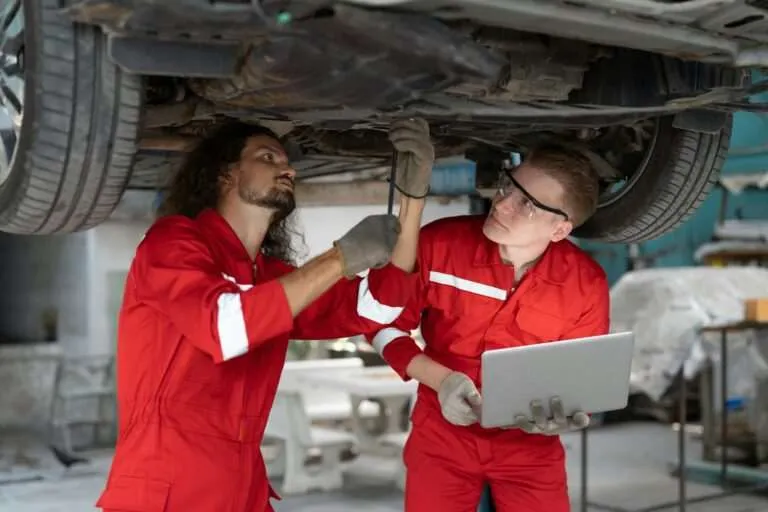
Axles transmit the power of your engine to the drive wheels. On front-wheel-drive vehicles, constant velocity (CV) axles connect the transaxle to each front wheel and flex as the suspension moves and the wheels steer. Rear-wheel-drive vehicles use axle shafts inside a differential housing, and all-wheel-drive vehicles typically use both.
CV joints are packed with grease and sealed by rubber boots. When a boot tears, grease escapes and dirt gets in, and the joint wears quickly.
Signs of axle or CV joint wear
- Clicking or popping when turning, especially in parking lots
- Grease splattered on the inside of the wheel or suspension
- A torn or cracked CV boot
- Vibration during acceleration
- Clunking when shifting or getting on and off the throttle
What we do
We inspect CV boots and joints, check for play at the inner and outer joints, and look at axle seals for leaks. On rear-wheel-drive vehicles, we check axle bearings and seals inside the differential housing.
If a boot has just torn and the joint is still quiet, it may be possible to reboot it. Most of the time, a complete replacement axle is the more reliable repair, and it restores both joints at once.
Driving in Concord and Contra Costa County
Tight turns in crowded parking lots and the curving roads through Contra Costa's hills are where a worn CV joint makes itself known first. If you hear clicking at full lock, have it checked before the joint separates.
Questions about axle & cv joint
Can I drive with a clicking CV joint?
For a short time, but it will get worse. A joint that fails completely can leave you without drive to that wheel. Have it inspected soon.
Is a torn CV boot an emergency?
Not immediately, but it should be addressed quickly, before lost grease and dirt damage the joint.
Published by Anywhere Automotive, Concord, CA. Diagnosis and pricing are confirmed after inspection.